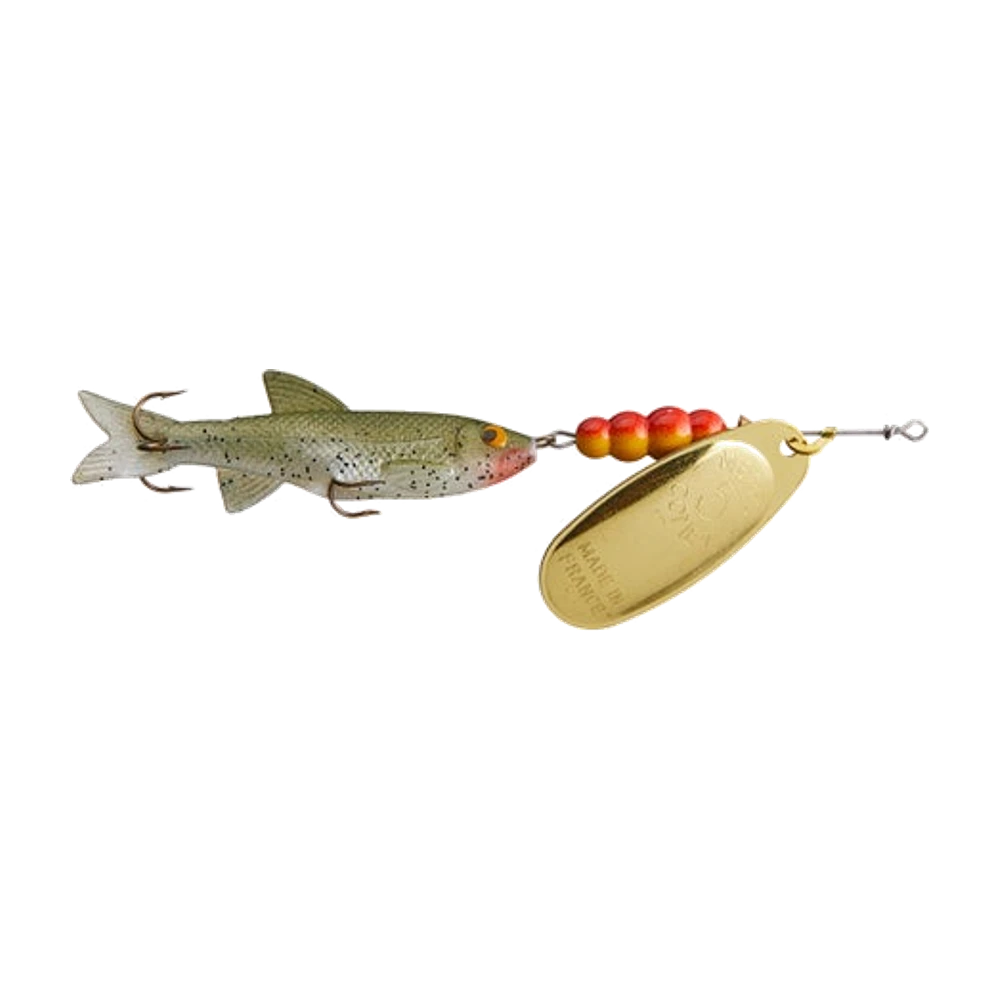
Mepps Comet: the inline spinner for rough water and current
Not sure this lure fits YOUR spot today? CarnaFish tells you in 10 seconds, from a photo.
Mepps built its reputation on the Aglia, the most copied inline spinner in fishing history. But tucked into the French brand's catalog is a lesser-known model that's formidable in one very specific context: the Comet, built for water that moves.
What sets the Comet apart from the Aglia
The difference comes down to blade shape. The Aglia spins at a maximum angle of about 60°, a compact, steady motion. The Comet, with a more oval, wider blade, spins at a tighter angle but with a much bigger flutter amplitude — it "slaps" the water harder. That big flutter carries better through strong current or particle-laden water, where the Aglia's more subtle motion gets lost.
Why it's the right spinner in fast water
In strong current, a spinner with too subtle a motion becomes hard for a pike hunting by vibration as much as sight to detect. The Comet, by flapping harder, sends a signal that carries through the current's ambient noise. That's exactly why it's historically been the go-to on high-flow rivers and back-eddies, where a slimmer spinner would go almost unnoticed.
A spinner you can't feel vibrating through the rod in rough water is doing nothing — the fish won't feel it either.
Sizes worth knowing
- #1 (3.5g): the low-key size, for small rivers or average pike in calm water.
- #2 (4.5g): the most versatile size, the default choice on an unfamiliar spot.
- #3 (6.5g): casts further and fishes a bit deeper on a slower retrieve.
- #4 (8g): reserved for big water or strong-current rivers, where weight is needed to stay in contact.
The retrieve: constant speed above all
An inline spinner has one rule: keep enough speed for the blade to spin without stalling. Too slow, and the blade stalls, killing the lure's whole effectiveness. The base technique stays a steady cast-and-retrieve, occasionally punctuated with small bursts of speed to change the flutter rhythm and trigger a reaction strike from a pike that's following without committing.
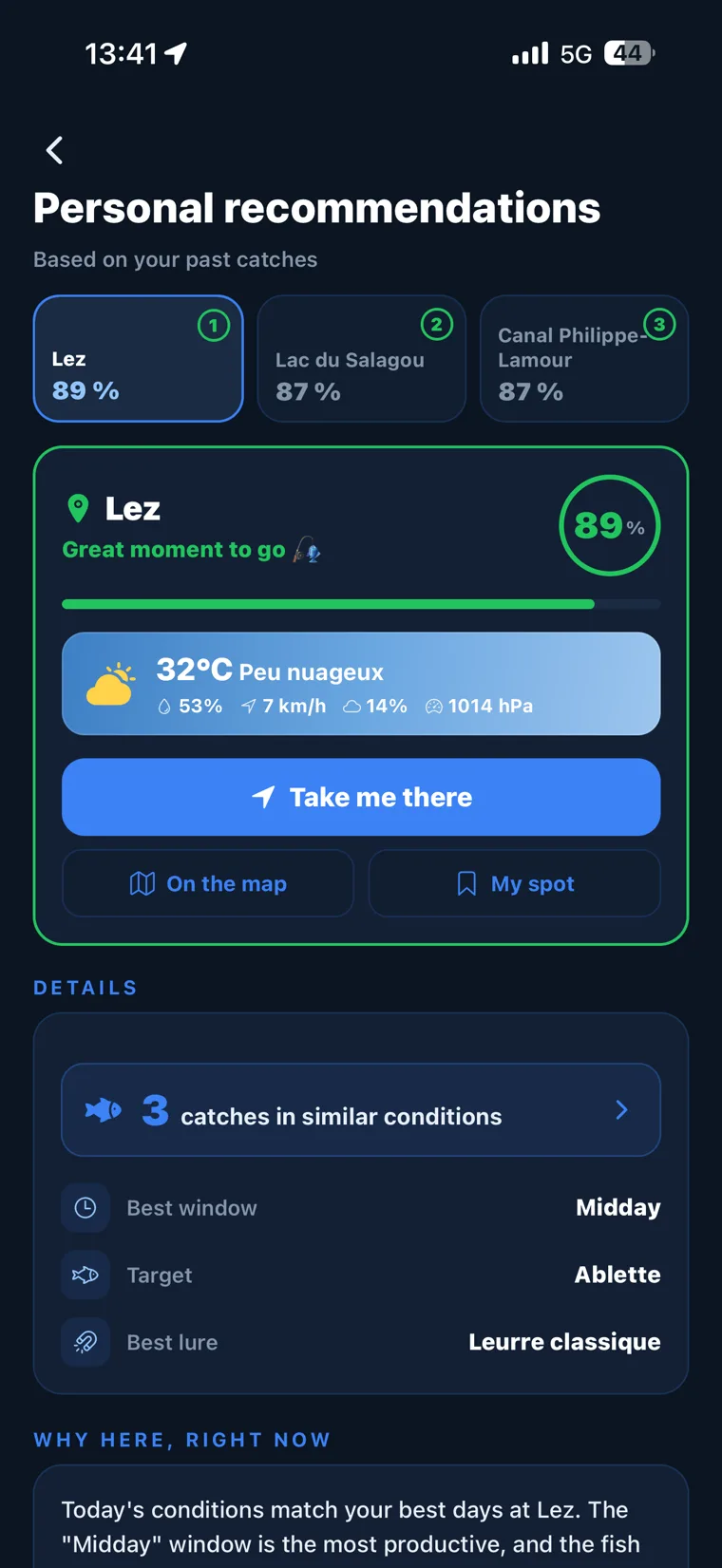
Not sure what to tie on?
Photograph your spot: CarnaFish reads the scene, cross-checks the conditions and gives you the zone, the lure and the retrieve. Free on iOS and Android.
Versus the Aglia: when to pick which
In calm, clear water, the Aglia #3 is often still the better call: its finer, more natural motion disturbs a wary pike less in flat water. As soon as current picks up or the water stains, the Comet takes the lead thanks to its stronger flutter, easier to detect in degraded conditions.
Colors and contrast
- Clear water: plain silver or gold, tones that faithfully reproduce a scale's natural flash.
- Stained water or heavy current: red dots or a fluo back, to add an extra visual cue on top of the blade's flash.
- Low light: favour gold, which carries better than a too-pale silver under an overcast sky.
The best signal in the world does nothing if there's no pike on the spot, or if the current isn't what you think it is — that's the whole point of CarnaFish, which reads a photo of the spot and suggests a technique matched to actual conditions rather than a gut feeling. For the full strategy on this species, our pike lure guide is worth reading alongside this sheet.
For the tackle box
- The Comet flutters harder and wider than the Aglia: the spinner to favour in fast, rough, or stained water.
- #2 as the default size, #4 reserved for strong-current rivers or big water.
- Always keep enough speed to hold the blade in continuous rotation.
- A wire leader is essential on a pike spot, regardless of spinner size.
FAQ
What's the difference between the Mepps Comet and Aglia?
The Comet has a wider, more oval blade that produces a bigger flutter, effective in rough or stained water. The Aglia spins with a finer, steadier motion, better suited to calm, clear water.
What size Comet should I start with?
The #2 (4.5g) is the most versatile size, suited to most rivers and lakes holding average pike. Only step up to a #4 on big water or in strong current.
Why isn't my spinner spinning properly?
Your retrieve speed is probably too slow: an inline spinner needs a minimum steady speed to keep the blade turning without stalling. Speed up the retrieve slightly to restore the flutter.
Does the Comet work well in strong-current rivers?
Yes, it's actually one of its best uses. Its wide flutter carries better through current noise than a spinner with a more subtle motion, making it easier for pike to detect.
Do I need a swivel with an inline spinner?
Yes, always. Without a snap swivel, the blade's rotation twists your line or braid within a few casts, which eventually fouls subsequent casts and damages the line.
What color Comet works best in stained water?
Favour a blade with red dots or a fluo back, adding an extra visual cue on top of the metallic flash. In very coloured water, gold generally carries better than silver.
The full pike lure guideSeason-by-season strategy: which family of lure, when, and why.Go from theory to fish
CarnaFish reads your spot from a photo and gives you the game plan: zone, lure, retrieve. Free on iOS and Android.