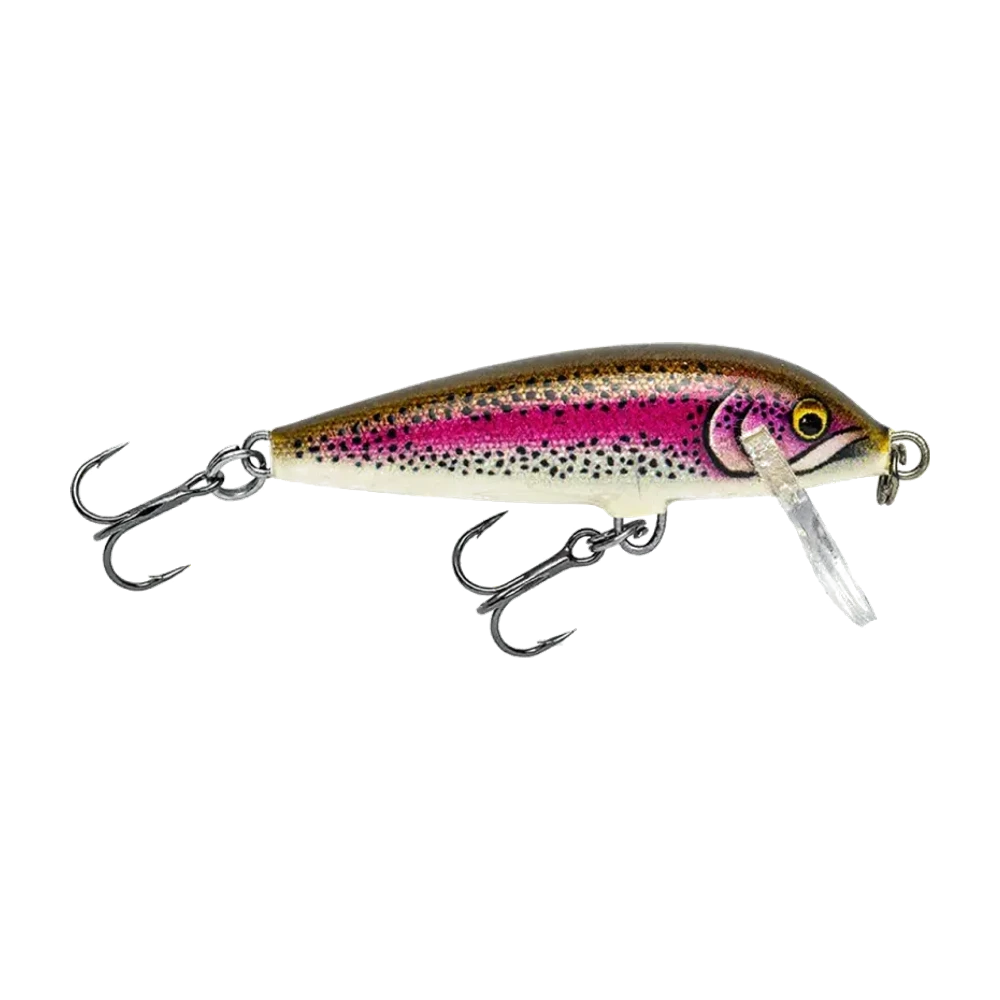
Rapala CountDown: the sinking minnow that sets its depth by the clock
This lure shines under specific conditions. CarnaFish tells you in 10 seconds if today is one of them.
A floating minnow fishes the surface and the first few inches. A standard sinking lure goes down, sure, but at what rate, and to what depth exactly? The Rapala CountDown answers that with a simple, remarkably effective idea: it sinks at a known, constant rate, which lets you dial in the exact depth where it starts swimming, down to the second.
The countdown principle
Every CountDown sinks at a steady rate, generally around 30 cm (1 ft) per second depending on the model. In practice: cast, count the seconds before you start reeling, and you know exactly what depth your lure begins swimming at. This isn't a marketing gimmick — it's the only real way to present a minnow precisely in the water column where a trout was spotted holding at a given depth, instead of guessing.
Field rule: always note your count the moment you get a strike. The next strike often comes at the same count, on the same type of spot.
Dialing in depth by the clock
- Cast and let it sink, counting quietly or in your head.
- Start reeling the moment you hit your target count — too early and you're fishing too shallow; too late and you risk snagging bottom.
- Adjust by trial and error: if you keep snagging, cut a second off the count. If you're getting nothing, add one.
- Reuse the winning count on similar spots along the same stretch.
Reading a riffle-to-pool transition with a sinker
The CountDown really earns its place at the tail-out of a riffle and in pools where the water slows and deepens: these spots often hold a fairly constant depth over several metres, which makes the count especially reliable cast after cast. On a more irregular spot (a sloping current seam), the count becomes a starting point to fine-tune rather than a fixed rule. Our guide to river trout fishing covers the classic spots where this kind of presentation shines.
Not sure what to tie on?
Photograph your spot: CarnaFish reads the scene, cross-checks the conditions and gives you the zone, the lure and the retrieve. Free on iOS and Android.
Retrieve: somewhere between a minnow and a spoon
Once you've hit your target depth, two approaches work well:
- Slow straight retrieve with micro-pauses: let the CountDown swim on its own, adding short pauses every few seconds that let it drop slightly — often the exact moment a strike comes.
- Subtle twitching: small rod-tip taps that sharpen the lure's natural shimmy, useful on a trout that's following without committing.
The CountDown stays naturally subtle by design: no big lip, no exaggerated vibration. It's a precision lure more than a power lure, best saved for trout that have already seen plenty of spinners that season.
What sets it apart from a lipped crankbait
Unlike a lipped crankbait such as the D-Contact, the CountDown has no plastic bib dictating its depth — weight and fall time alone decide it. That makes it quieter on landing and more precise for targeting an exact depth, at the cost of a less flashy swim.
The right depth setting never replaces reading the spot — that's exactly what CarnaFish offers, reading a photo of your spot against the day's conditions to suggest a zone and a starting depth before you even count your first cast.
Key takeaways on the countdown system
- Constant sink rate (about 30 cm/1 ft per second): count seconds to dial in the exact depth.
- Note the winning count on every strike so you can repeat it on similar spots.
- Ideal on pools and riffle tail-outs with a fairly even depth.
- A subtle swimmer: a precision lure rather than a flash lure, great on wary trout.
FAQ
How does the CountDown sink system work?
The lure sinks at a known, constant rate (roughly 30 cm/1 ft per second depending on the model). By counting seconds after the cast before you start reeling, you know exactly what depth it starts swimming at.
What size CountDown should I use for trout?
The CD3 and CD5 models, between 3 and 5 cm, cover most trout rivers. Save larger sizes for bigger fish or wider, deeper water.
How do I avoid snagging bottom with this lure?
Cut a second off your count after each snag until you find the depth that runs just above bottom. It's a fine-tuning process rather than an exact science, but it becomes intuitive fast.
Where does this lure work best?
Pools at the tail of a riffle and stretches with a fairly even depth are ideal, since the count stays reliable cast after cast. On uneven bottom, adjust the count on every cast.
How is it different from a lipped crankbait?
The CountDown has no wide lip: weight and fall time set the depth, not a plastic bib. It's quieter on landing but swims with less flash than a crankbait.
Should I twitch it or retrieve it straight?
Both work. A slow straight retrieve with micro-pauses is the baseline; subtle twitching helps on a trout that's following the lure without deciding to strike.
The full trout lure guideSeason-by-season strategy: which family of lure, when, and why.Go from theory to fish
CarnaFish reads your spot from a photo and gives you the game plan: zone, lure, retrieve. Free on iOS and Android.